

Because the Nissan has the gift that keeps giving, my NV 3500 had another misfire event today, getting on the freeway, towing the horse trailer, giving it a bit of oomph to get up to speed, downshift, we're good at ~3500RPM, downshift again, ~5000RPM and... check engine light starts blinking. 
OK OK, off the throttle, car shifts up, on the throttle again, CEL stops blinking.... all is well.... Fine I'll baby it home.
So I throw the symptoms at Claude:
OK, cool, seems reasonable, nothing that speaks "engine is going to hand grenade", the fuel pump being an asshole would be a problem, the spark plugs being at the end of their life is a high possibility (I couldn't remember off the top of my head when I last had those replaced).
Then I decided to do something fun.
I dumped a torque log into Claude.
Bank 1 cat is shot, nothing new, but the data in a graph is nice to see.
Kicking myself in the butt for not having the log enabled all the time (because why not?!), so check back in within a week, I'll probably try to trigger it again (as soon as tomorrow though).
Let's see if Claude can dig through my Torque data and see if anything interesting falls out, next time!
OK OK, off the throttle, car shifts up, on the throttle again, CEL stops blinking.... all is well.... Fine I'll baby it home.
So I throw the symptoms at Claude:
A flashing CEL means the misfire is bad enough to dump raw fuel into the exhaust, so the engine's telling you to back out of the throttle when it happens — which it sounds like you did. The pattern here is actually pretty diagnostic: it only misfired at high load and high RPM, and it's P0300 (random/multiple) rather than a single cylinder. That points to something system-wide that can't keep up at peak demand, rather than one dead coil. On a 175k VK56 towing a horse trailer, the usual suspects in rough order:
- Spark plugs past their prime. This is the #1 cause of load-only misfires. Cylinder pressure at wide-open throttle makes it much harder for spark to jump a worn, widened gap, so marginal plugs run fine cruising and break down exactly when you floor it. If you don't know when they were last done (Nissan says ~105k), start here — it's cheap and overdue anyway.
- Weak coil(s). Same logic — coils that are marginal fail under load first. VK56 coils also suffer when valve cover gaskets seep oil into the plug wells, so pull a few coils and look for oil.
- Fuel starvation. A tired in-tank pump or dirty injectors can supply enough fuel to cruise but go lean at 5000 RPM towing, and lean misfire hits multiple cylinders at once — a perfect P0300. A dirty MAF underreporting airflow does the same thing.
- That cat you told me to ignore. I'll ignore the P0420 code, but not the hardware: a converter that's been dead for 5 years can break up internally and start plugging the exhaust. A restriction barely matters at light throttle but chokes the engine at exactly max load/RPM — and every flashing-CEL misfire cooks it further. Worth ruling out.
Vacuum leaks, for what it's worth, are unlikely here — they cause idle misfires, not WOT ones.
Where I'd start: since you've clearly got an OBD app, watch long-term fuel trims and the per-cylinder misfire counters while driving. Trims climbing past ~+10% under load says lean (fuel/MAF); one cylinder racking up counts says coil/plug on that hole; even counts across all eight says fuel pressure or exhaust restriction. A fuel pressure test under load and a backpressure check on the cat (or an intake vacuum gauge at revs) settle the last two. And one cheap experiment: run mid-grade or premium when towing — 87 octane plus a heavy trailer on a hot ramp invites knock, and the fix costs a few bucks to test.
I'd sort this before the next trip with horses aboard, mainly because a misfire that's marginal today tends to get worse under sustained towing load, and you don't want it turning into a limp-mode situation halfway up a grade.
OK, cool, seems reasonable, nothing that speaks "engine is going to hand grenade", the fuel pump being an asshole would be a problem, the spark plugs being at the end of their life is a high possibility (I couldn't remember off the top of my head when I last had those replaced).
Then I decided to do something fun.
I dumped a torque log into Claude.
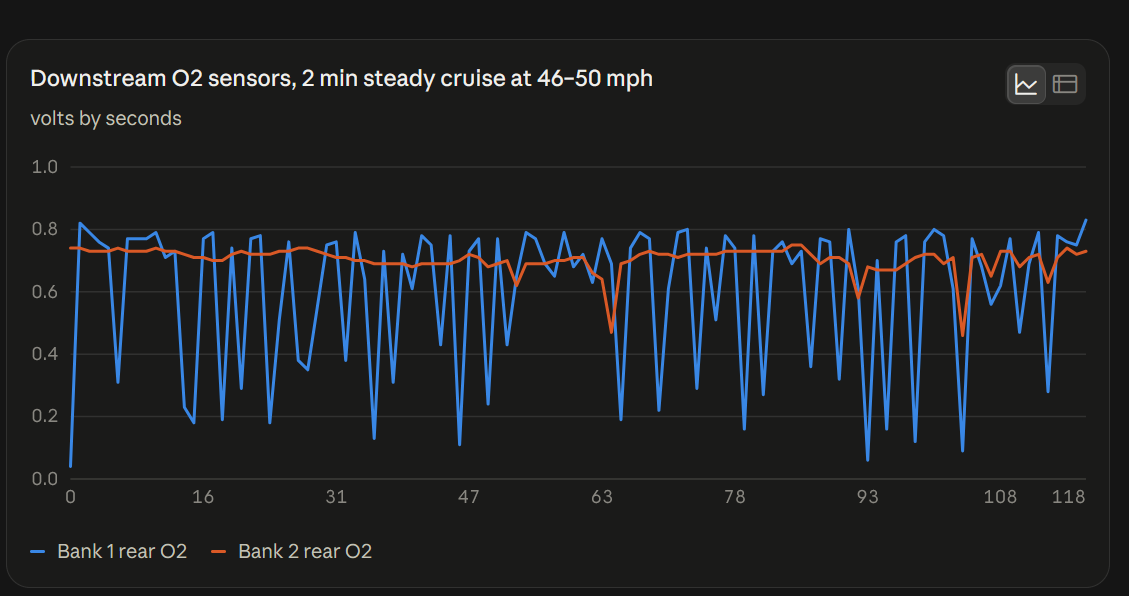
Bank 1's rear sensor is just echoing the front sensor — no catalyst activity at all — while bank 2's sits flat at ~0.7 V the way a working cat should.
A few smaller things: the tank went from 20% to 15% during this drive, so you were pulling the trailer on roughly 4–5 gallons in a 28-gallon tank. Low fuel means slosh under hard acceleration and a hotter pump — fill it before you try to reproduce the misfire, so you're not chasing a ghost. Charging voltage sits at 13.7 V and dips to ~13.0 at hot idle, which is a touch low but not a fault. Coolant (174–198°F), modeled cat temps (1,040–1,220°F), and the short-term trim blips after decel fuel cut are all normal.
Net effect on the earlier list: this log makes knock/detonation under towing load a stronger candidate and doesn't move plugs or coils either way. If you can, log the next hard pull with the Torque misfire counters (Mode 06) enabled — a single loud cylinder vs. all eight would settle a lot.
Bank 1 cat is shot, nothing new, but the data in a graph is nice to see.
Kicking myself in the butt for not having the log enabled all the time (because why not?!), so check back in within a week, I'll probably try to trigger it again (as soon as tomorrow though).
Let's see if Claude can dig through my Torque data and see if anything interesting falls out, next time!