
Using Claude To Troubleshoot A Misfire... (in progress)

StrangeWill

Administrator
Staff member
Because the Nissan has the gift that keeps giving, my NV 3500 had another misfire event today, getting on the freeway, towing the horse trailer, giving it a bit of oomph to get up to speed, downshift, we're good at ~3500RPM, downshift again, ~5000RPM and... check engine light starts blinking. :angryface:


OK OK, off the throttle, car shifts up, on the throttle again, CEL stops blinking.... all is well.... Fine I'll baby it home.

So I throw the symptoms at Claude:

A flashing CEL means the misfire is bad enough to dump raw fuel into the exhaust, so the engine's telling you to back out of the throttle when it happens — which it sounds like you did. The pattern here is actually pretty diagnostic: it only misfired at high load and high RPM, and it's P0300 (random/multiple) rather than a single cylinder. That points to something system-wide that can't keep up at peak demand, rather than one dead coil. On a 175k VK56 towing a horse trailer, the usual suspects in rough order:


  • Spark plugs past their prime. This is the #1 cause of load-only misfires. Cylinder pressure at wide-open throttle makes it much harder for spark to jump a worn, widened gap, so marginal plugs run fine cruising and break down exactly when you floor it. If you don't know when they were last done (Nissan says ~105k), start here — it's cheap and overdue anyway.
  • Weak coil(s). Same logic — coils that are marginal fail under load first. VK56 coils also suffer when valve cover gaskets seep oil into the plug wells, so pull a few coils and look for oil.
  • Fuel starvation. A tired in-tank pump or dirty injectors can supply enough fuel to cruise but go lean at 5000 RPM towing, and lean misfire hits multiple cylinders at once — a perfect P0300. A dirty MAF underreporting airflow does the same thing.
  • That cat you told me to ignore. I'll ignore the P0420 code, but not the hardware: a converter that's been dead for 5 years can break up internally and start plugging the exhaust. A restriction barely matters at light throttle but chokes the engine at exactly max load/RPM — and every flashing-CEL misfire cooks it further. Worth ruling out.

Vacuum leaks, for what it's worth, are unlikely here — they cause idle misfires, not WOT ones.

Where I'd start: since you've clearly got an OBD app, watch long-term fuel trims and the per-cylinder misfire counters while driving. Trims climbing past ~+10% under load says lean (fuel/MAF); one cylinder racking up counts says coil/plug on that hole; even counts across all eight says fuel pressure or exhaust restriction. A fuel pressure test under load and a backpressure check on the cat (or an intake vacuum gauge at revs) settle the last two. And one cheap experiment: run mid-grade or premium when towing — 87 octane plus a heavy trailer on a hot ramp invites knock, and the fix costs a few bucks to test.

I'd sort this before the next trip with horses aboard, mainly because a misfire that's marginal today tends to get worse under sustained towing load, and you don't want it turning into a limp-mode situation halfway up a grade.

OK, cool, seems reasonable, nothing that speaks "engine is going to hand grenade", the fuel pump being an asshole would be a problem, the spark plugs being at the end of their life is a high possibility (I couldn't remember off the top of my head when I last had those replaced).


Then I decided to do something fun.

I dumped a torque log into Claude.
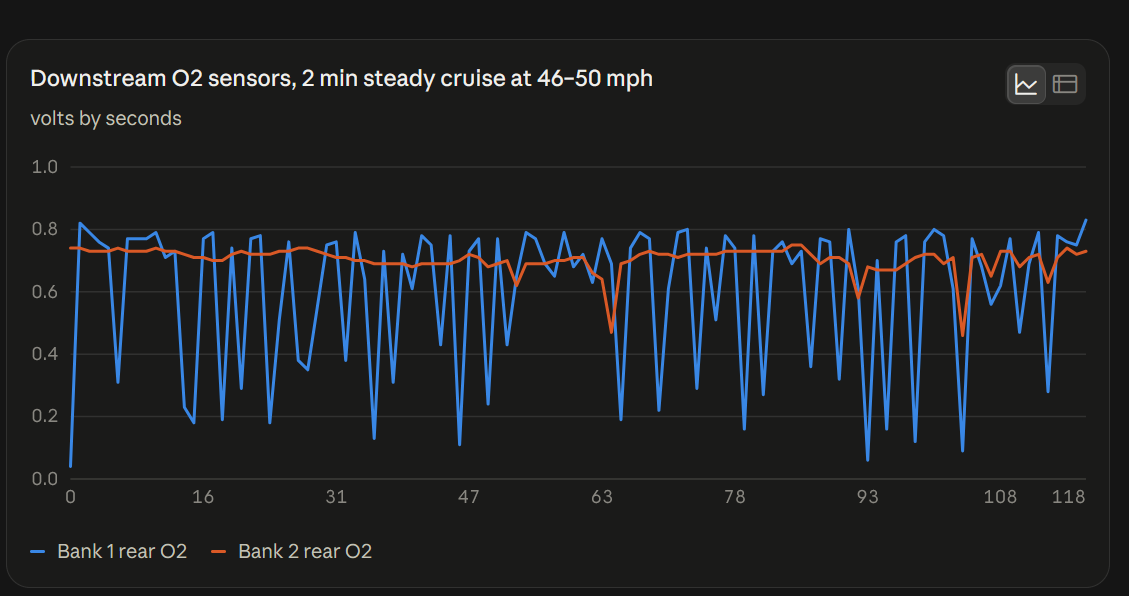
1788130478351.png


Bank 1's rear sensor is just echoing the front sensor — no catalyst activity at all — while bank 2's sits flat at ~0.7 V the way a working cat should.

A few smaller things: the tank went from 20% to 15% during this drive, so you were pulling the trailer on roughly 4–5 gallons in a 28-gallon tank. Low fuel means slosh under hard acceleration and a hotter pump — fill it before you try to reproduce the misfire, so you're not chasing a ghost. Charging voltage sits at 13.7 V and dips to ~13.0 at hot idle, which is a touch low but not a fault. Coolant (174–198°F), modeled cat temps (1,040–1,220°F), and the short-term trim blips after decel fuel cut are all normal.

Net effect on the earlier list: this log makes knock/detonation under towing load a stronger candidate and doesn't move plugs or coils either way. If you can, log the next hard pull with the Torque misfire counters (Mode 06) enabled — a single loud cylinder vs. all eight would settle a lot.

Bank 1 cat is shot, nothing new, but the data in a graph is nice to see.

Kicking myself in the butt for not having the log enabled all the time (because why not?!), so check back in within a week, I'll probably try to trigger it again (as soon as tomorrow though).

Let's see if Claude can dig through my Torque data and see if anything interesting falls out, next time!
 
Torque also really badly needs a "shut up and log EVERYTHING" button BTW.


Edit: On second thought this reduces my sensor resolution, so I need to cut that out.
 
Last edited:
So Claude had flagged NTB17-016c with the following details:

There's a Nissan bulletin for what your log shows. NTB17-016c covers the 2017 NV2500/3500 with this engine and 7-speed, for a lack of power at low speeds under light acceleration that feels like the transmission is holding too high a gear, along with shift shock on a 7th-to-3rd downshift; the fix is reprogramming the TCM. That's the lugging in 7th, and the downshift it describes is the maneuver you were doing when the light flashed. It's a stretch, but a harsh kickdown that jolts the driveline can be misread by the misfire monitor, which works by watching for crankshaft-speed hiccups. If yours is a 2017, a dealer can check the TCM part number against the bulletin in a minute; it's a reflash, not a repair, and may already have been done.

Well hold on, it's kind of drawing a faint line between the two, I didn't get a shift shock, I don't have hesitancy in the downshift.


So I prompt:

NTB17-016c doesn't cover "stuck in 7th" behavior or lugging or anything of the sort, just a hesitation to downshift at low speeds?

You're right, and I stretched it. The bulletin lists three complaints: shift shock when accelerating hard enough to force a 7th-to-3rd downshift, a small RPM flutter at steady speed, and a lack of power under light acceleration at lower speeds that feels like the gear is too high, which they also describe as hesitation. That last item is a response complaint — you ask for a little more, the transmission is slow to give you a lower gear — not a statement that the calibration holds high gears under sustained heavy load. It says nothing about towing or lugging, and the log can't show whether you felt a hesitation anyway. I shouldn't have labelled the 7th-gear, 85%-load stretches as "the bulletin's behavior."

Yeah so sort of wild goose chase, may be worth knowing about, but very very unlikely to be related
 
1788711025472.png


They start together, then split. By 3,300 rpm bank 2's trim is climbing — the ECU sees that side lean and pours in fuel, pegging at +19.5% near the top — while bank 1 goes the other way, pinned at −10% with its wideband reading progressively rich, down to λ 0.78. That divergence is the finding. A weak pump or sagging rail pressure starves both banks together; one bank lean while the other runs rich is a bank-specific problem. And timing held 11–18° all the way up — no knock retard. So in one pull, this log largely retired the fuel-pump theory and the knock theory for this event, and put the problem on bank 2, the driver side, cylinders 2-4-6-8 — which, for what it's worth, is the side with the good catalyst, and these events are feeding it raw mixture.


There are two stories that fit, and one wrinkle that matters for choosing between them. A misfiring cylinder passes unburnt mixture, and unburnt mixture reads lean on a wideband because of the leftover oxygen — so a real ignition or injector failure on bank 2 at high load produces exactly this: sensor reads lean, ECU compensates hard. That's story one. Story two: the bank 2 wideband never reported a single value in this entire log — the column is 100% blank, though it worked fine on August 31. If that sensor is dying, it may be lying lean at high flow, making the ECU over-fuel bank 2 until the cylinders go too rich to fire. Same symptom, opposite root cause, and a much cheaper fix — an upstream air-fuel sensor runs maybe $150–300 installed versus the pump money.


Three things settle it, in order. First, read Test Results now, before anything clears codes — this drive cycle's misfire counts are sitting in Mode 6. One or two loud cylinders, both on bank 2, means coil, plug, or injector on those holes; all four bank-2 cylinders roughly even means the whole bank's fueling was off, which is the sensor story. Second, check Fault Log Manager for new codes beyond the P0300 — anything in the P0150s or P2A00s pointing at a bank 2 sensor would nearly close the case. Third, on your next connect, see whether the bank 2 wideband PID shows data at all; if bank 1 answers and bank 2 still won't, that silence is evidence in itself. And add "O2 Bank 2 Sensor 2 Voltage" — the downstream sensor — back into the list: it's slow but honest, and during a pull it will say whether bank 2 truly ran lean or was actually drowning in fuel, which arbitrates between the stories without trusting the suspect sensor.


One familiar note: the long lugging stretch later in the log — 90% load at 1,300–1,500 rpm, timing at 0° — looked exactly like the previous drives, stoich, no misfire signature. Different phenomenon, same advice as before.


If you can get me the Mode 6 counts — even a photo of the Test Results screen — I'll tell you which of the two stories you're in.

Forced a misfire while moving the trailer to the house, gunned it up a hill, questionable noises around 4000 RPM and a check engine light, bingo.

I need to grab the additional test scans, let's see where this goes...
 
"Looks like misfires across the entire bank"
Close, but look again at which cylinders: 1, 3, 5, 7 — counts of 4, 6, 2, 2 — with dead zeros on 2, 4, 6, 8. That's all four cylinders of one bank, but it's bank 1, the passenger side. The opposite side from the one I called. I read the trim split as "bank 2 lean, therefore bank 2 misfiring," and the ECU's own misfire counters just overruled me.


Two notes on the numbers themselves before the reinterpretation. Those are EWMA values — averaged over the last ten drive cycles — so the Saturday event was bigger than 14 misfires; averaged down like that, it was plausibly a few dozen in that one pull. And the current-cycle zeros are expected, since your key-on read session is itself a fresh cycle. So: a burst of misfires, spread evenly across one whole bank, during the pull.


That even spread is the most informative thing yet. One dead coil, plug, or injector puts a big number on one cylinder. Four cylinders on the same bank misfiring together means the whole bank's mixture went wrong — and now go back to what bank 1 was doing during the pull: its wideband read progressively richer down to λ 0.78 while the ECU pulled fuel at the −10% clamp the whole way. Two ways to read that pair of facts. Either bank 1 truly went that rich and rich-misfired — but there's no good mechanism for one bank of a shared-rail engine to over-fuel itself against a pegged-lean trim. Or the bank 1 sensor is lying rich, the ECU has been pulling fuel to satisfy it, and the bank actually ran lean at the top of the pull — lean misfire under load, the textbook kind. That second story also explains something we've seen since the first log: bank 1's long-term trim parked at −7% for days. A rich-biased, 175k-mile air-fuel sensor produces exactly that chronic offset, and a sensor that's biased at cruise falls apart hardest at maximum exhaust flow. Meanwhile the bank 2 wideband answered nothing for an entire log, which means its +19.5% trim track — the line I built my bank 2 call on — came from a sensor I can't vouch for either. The front sensors, not the cylinders, are now the prime suspects.


Also: your paste starts mid-line — the top of the report is cut off, and that's the part with the O2/air-fuel sensor monitors and catalyst monitors. Send the beginning if you have it; the sensor monitor results may indict bank 1's sensor directly.


Where this leaves the plan. The plugs are due at 175k anyway, and pulling them is now doubly useful: four porcelains from the passenger bank will say rich (sooted black) or lean (chalky white) without trusting any sensor. If the report top or the plugs point the same direction, both upstream air-fuel sensors — OEM, Denso or NTK, not bargain clones — at roughly $350–600 installed for the pair is the indicated fix, and it's one of the cheapest outcomes that was ever on the table. What's off the table is more interesting: single-cylinder ignition parts, knock, and most of the fuel-pump scenarios. The van is narrowing this down nicely.

(After fixing the log)
Now the top half rewrites the story again, in a useful way. Three things in it matter:

  • Both front air-fuel sensors pass their monitors. B1S1 and B2S1 posted nearly identical response numbers (539/491 and 491/443 against a 1,300 ceiling) with healthy margins. Caveat: this monitor tests whether a sensor responds, not whether it's calibrated right at 180 g/s of exhaust flow — a drifted sensor can still pass. But there's no indictment here, and bank 2's sensor answering its monitor means it isn't electrically dead; the blank column in Saturday's log was probably Torque failing to poll it that session. My "front sensors are the prime suspects" theory just lost most of its support.
  • The bank 1 catalyst monitor didn't just fail, it failed by half. Efficiency index 10 against a minimum of 23, while bank 2 passed at 69 with triple the floor. We knew bank 1's cat was dead from the rear-O2 trace; this is the ECU putting a number on how dead.
  • VVT monitors are clean on both banks — small corrections, all passing — which quietly retires another load-misfire candidate, a lazy cam phaser.
Here's the story that now fits every observation at once. A catalyst that's been dead for five years doesn't stay inert — the ceramic brick cracks, crumbles, and starts acting like a flow-dependent plug. At cruise, bank 1 breathes fine. At peak flow, the restriction backs exhaust up into bank 1's cylinders, so each intake stroke on that side pulls in less fresh air. The fuel keeps coming per the MAF, so bank 1's wideband reads rich — your λ 0.78 — and the ECU pulls fuel to its −10% clamp and still can't lean it out, which is exactly what the log shows and what no injector or sensor story explained cleanly. Meanwhile cylinders full of recycled exhaust and over-rich mixture stop lighting reliably: dilution misfire, spread evenly across all four bank 1 cylinders, only at high RPM and load, worst when towing holds the flow up there. That's your flashing light. The one component you told me to ignore in the first message has spent three weeks becoming the prime suspect, and every misfire event dumps raw fuel into what's left of it, so it's self-accelerating.

It doesn't explain bank 2's +19.5% lean climb. That's either a real whole-engine fuel-supply limit at peak demand or that sensor being imperfect at high flow — genuinely open, but second-order: it wasn't the bank that misfired.

The confirmation is cheap and mechanical, no electronics involved. First, cold engine, rubber mallet, rap the bank 1 cat — loose substrate rattles like gravel. Second, and definitive: a shop unscrews the bank 1 upstream sensor, threads a pressure gauge into the hole, and reads exhaust backpressure at revs — sustained readings past roughly 3 psi at 2,500 rpm mean restriction, and it's under an hour of labor. If it confirms, the fix is the cat replacement we already priced — $300–600 for a weld-in universal up to $1,200 direct-fit — plus a look downstream for ceramic debris that may have migrated. With the exhaust open and the van in the air, that's the visit to do the 175k plugs, and I'd read the bank 1 plugs' porcelain on the way out as a free cross-check: sooty black says the rich readings were real.

Then the same logging rig you've built gets the final word: one towed pull after the repair, trims staying matched, Mode 6 staying zero. If bank 2's lean climb persists at peak flow with a healthy exhaust, we chase the fuel supply then — but there's a fair chance the whole three-week mystery comes down to the cat.

"So CAT could cause restriction, but is that CAT on the bank misfiring? What about the rich drive?"

Yes — same side, and that alignment is most of the argument. On this engine each bank has its own exhaust manifold feeding its own catalyst, and the two pipes only merge further downstream. A blockage after the merge would choke both banks equally; a blockage in one bank's cat chokes only that bank's four cylinders. The failed catalyst monitor is bank 1, and the misfire counts are cylinders 1-3-5-7 — bank 1. The data localizes the restriction to the one piece of pipe that only those four cylinders breathe through. It also hands you a perfect experiment: when the shop does the backpressure test through the upstream sensor hole, have them do both banks. Bank 2 is the healthy control on the same engine, same day, same RPM — if bank 1 reads several psi higher, that's the answer with no interpretation required.


As for the rich reading — that's not a separate mystery the theory has to survive; it's the theory's fingerprint. Walk through the fueling logic. The MAF sits in the intake, ahead of the plenum both banks share, so it measures total air and the ECU deals fuel to each cylinder assuming everyone gets an equal slice. Now put a restriction behind bank 1. Its cylinders can't blow all the burned gas out before the exhaust valve closes, so some stays behind, and the leftover exhaust occupies space in the cylinder that fresh air was supposed to fill. Bank 1's cylinders are now taking in less fresh air than their assumed share — but the fuel keeps coming per the MAF math. Less air, same fuel: the mixture is truly rich, and the wideband honestly reported it. The ECU pulled fuel to its −10% limit and the reading kept sinking to 0.78 because at 180 g/s the fresh-air shortfall on that bank was bigger than 10%. Nothing was lying; the bank really was drowning.


It even explains the thing we noticed in your very first log and couldn't pin down: bank 1's long-term trim parked at −5 to −7% for weeks. A partly crumbled cat restricts a little at all flows, so bank 1 runs slightly air-short all the time — a chronic mild richness the ECU learned out at cruise. Then flow rises and the effect scales: −5% at 40 g/s, past the clamp at 180. Three logs' worth of trim behavior falls on that one curve.


The misfires themselves aren't from the richness — λ 0.78 lights fine. They're from what's causing the richness: that leftover exhaust gas is inert, and enough of it in the charge slows the flame until cylinders start failing to light at all. It behaves exactly like massive unintended EGR. So the rich trace and the misfires are siblings with one parent — exhaust that can't leave — which is why one theory covers a rich bank, an even four-cylinder misfire spread, load-and-RPM dependence, and five years of P0420, all on the same side of the engine.


Looks like new CAT time.
 
Back
Top